Search This Blog

Friday, November 27, 2015

California farm recalls produce used in Costco salad linked to E. coli | Fox News

A California farm is recalling a vegetable mix believed to be the source of E.coli in Costco chicken salad that has been linked to an outbreak that has sickened 19 people in seven states, the Food and Drug Administration said Thursday.
Taylor Farms Pacific Inc. of Tracy, California, has recalled a mix of diced celery and onion used in Costco chicken salad and other foods containing celery "out of an abundance of caution," the FDA said in a statement.


California farm recalls produce used in Costco salad linked to E. coli | Fox News

México confirma dos casos de personas con el virus zica - Univision

Esta semana el gobierno de Nicaragua declaró que “el virus zika ya esta en Centroamérica”. Este mismo jueves, la Secretaría de Salud de México confirmó dos casos de personas infectadas con este virus transmitido por el mosquito Aedes Aegypti, el mismo del dengue y la chikunguya.


México confirma dos casos de personas con el virus zica - Univision

Friday, November 20, 2015

Ahead of Print -Uveitis and Systemic Inflammatory Markers in Convalescent Phase of Ebola Virus Disease - Volume 22, Number 2—February 2016 - Emerging Infectious Disease journal - CDC

We report a case of probable Zaire Ebola virus–related ophthalmologic complications in a physician from the United States who contracted Ebola virus disease in Liberia. Uveitis, immune activation, and nonspecific increase in antibody titers developed during convalescence. This case highlights immune phenomena that could complicate management of Ebola virus disease–related uveitis during convalescence.


Ahead of Print -Uveitis and Systemic Inflammatory Markers in Convalescent Phase of Ebola Virus Disease - Volume 22, Number 2—February 2016 - Emerging Infectious Disease journal - CDC

Thursday, November 19, 2015

Ahead of Print -Epidemiology of Epidemic Ebola Virus Disease in Conakry and Surrounding Prefectures, Guinea, 2014–2015 - Volume 22, Number 2—February 2016 - Emerging Infectious Disease journal - CDC

In 2014, Ebola virus disease (EVD) in West Africa was first reported during March in 3 southeastern prefectures in Guinea; from there, the disease rapidly spread across West Africa. We describe the epidemiology of EVD cases reported in Guinea’s capital, Conakry, and 4 surrounding prefectures (Coyah, Dubreka, Forecariah, and Kindia), encompassing a full year of the epidemic. A total of 1,355 EVD cases, representing ≈40% of cases reported in Guinea, originated from these areas. Overall, Forecariah had the highest cumulative incidence (4× higher than that in Conakry). Case-fatality percentage ranged from 40% in Conakry to 60% in Kindia. Cumulative incidence was slightly higher among male than female residents, although incidences by prefecture and commune differed by sex. Over the course of the year, Conakry and neighboring prefectures became the EVD epicenter in Guinea. Transmission continues to linger in these areas, the last holdout of the epidemic, necessitating continued public health vigilance.


Ahead of Print -Epidemiology of Epidemic Ebola Virus Disease in Conakry and Surrounding Prefectures, Guinea, 2014–2015 - Volume 22, Number 2—February 2016 - Emerging Infectious Disease journal - CDC

Ahead of Print -Ebola Virus Persistence in Semen Ex Vivo - Volume 22, Number 2—February 2016 - Emerging Infectious Disease journal - CDC

On March 20, 2015, a case of Ebola virus disease was identified in Liberia that most likely was transmitted through sexual contact. We assessed the efficiency of detecting Ebola virus in semen samples by molecular diagnostics and the stability of Ebola virus in ex vivo semen under simulated tropical conditions.


Ahead of Print -Ebola Virus Persistence in Semen Ex Vivo - Volume 22, Number 2—February 2016 - Emerging Infectious Disease journal - CDC

Monday, November 16, 2015

USDA Embraces One Health Approach for Solving Problems Associated with Antimicrobial Resistance

From the #USDA:


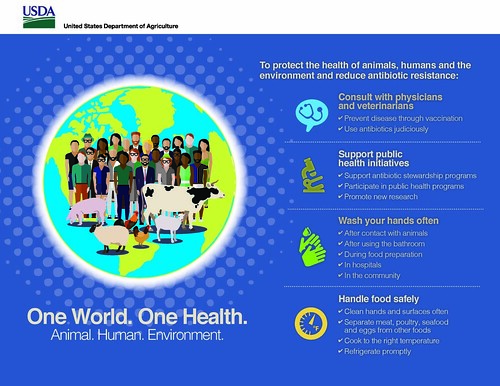
One World. One Health. Animal. Human. Environment infographic
One World. One Health. Animal. Human. Environment infographic. USDA photo (Click to enlarge)
This week is World Antibiotic Awareness Week and USDA remains focused on prolonging the usefulness of a very precious resource—antibiotics.  These medicines successfully treat and prevent infectious diseases and must be used responsibly to remain effective to all who need them.  USDA also recognizes that antimicrobial resistance, or the ability of bacteria and other microbes to survive the effects of an antibiotic and then proliferate, is a serious threat to both animal health and human health.
Earlier this year, the World Health Assembly developed a global action plan to combat antimicrobial resistance (AMR).  The five objectives of the plan are: Increasing awareness, strengthening research and surveillance, reducing infections, optimizing antimicrobial use, and ensuring sustainable investments to contain AMR.
At USDA, we use a One Health approach that embraces the idea that a problem such as AMR arising at the intersection of the health of humans, animals, and the environment can be solved only through a coordinated multidisciplinary approach.
Within USDA, there are eight agencies engaged in addressing some aspect of AMR: the Agricultural Research Service, the Agricultural Marketing Service, the Animal and Plant Health Inspection Service, the Economic Research Service, the Food Safety and Inspection Service, the Foreign Agricultural Service, the National Agricultural Statistics Service, and the National Institutes for Food and Agriculture. Our One Health Joint Working Group within USDA coordinates the work of these agencies for a comprehensive approach to address multiple facets of the issue.
Last year, USDA developed an AMR Action Plan based on broad stakeholder and federal partner feedback. The USDA AMR Action Plan outlines USDA’s current activities across USDA agencies and proposes a comprehensive, integrated approach for future activities that includes monitoring and surveillance; research and development; and education and outreach. Data collection through monitoring and surveillance provides the fuel for targetingresearch into epidemiology, ecology, and preventive health approaches allowing for development of critical mitigation strategies. Education and outreach are necessary to spread the word and enhance implementation of findings.
USDA’s AMR Action Plan provides the details of USDA’s responsibilities outlined in the Combating Antibiotic Resistant Bacteria (CARB) National Action Plan, developed with our federal partners. In both of these plans, we take advantage of the strengths of our existing activities and collective experience in animal agriculture and describe additional work necessary to fill knowledge gaps. 
Our understanding of the factors that contribute to development of infectious disease, which includes those that are resistant to antibiotics in various settings, is incomplete. Agricultural systems are diverse and complex even within a specific commodity group. To identify and apply effective mitigation strategies, it is critical for many disciplines to work together to improve our understanding of where pathogens originate, how they interact in the environment, and how we can effectively diminish their occurrence. A “One-Health” approach is needed to prevent, not just react to, complex public and animal health issues. We also recognize that for prevention to be effective, we need to invest resources in a variety of strategies.  Risk management requires collaboration among human, animal, and environmental sectors.
The theme of the World Antibiotic Awareness Week campaign this year is, Antibiotics: Handle with Care. You can find what some of our stakeholders are doing to preserve this valuable resource through a Fact Sheet distributed during the White House Forum on Antibiotic Stewardship held June 2, 2015.
    

Thursday, November 12, 2015

Ahead of Print -Identifying and Reducing Remaining Stocks of Rinderpest Virus - Volume 21, Number 12—December 2015 - Emerging Infectious Disease journal - CDC

In 2011, the world was declared free from rinderpest, one of the most feared and devastating infectious diseases of animals. Rinderpest is the second infectious disease, after smallpox, to have been eradicated. However, potentially infectious rinderpest virus material remains widely disseminated among research and diagnostic facilities across the world and poses a risk for disease recurrence should it be released. Member Countries of the World Organisation for Animal Health and the Food and Agricultural Organization of the United Nations are committed to destroying remaining stocks of infectious material or ensuring that it is stored under international supervision in a limited number of approved facilities. To facilitate this commitment and maintain global freedom from rinderpest, World Organisation for Animal Health Member Countries must report annually on rinderpest material held in their countries. The first official surveys, conducted during 2013–2015, revealed that rinderpest material was stored in an unacceptably high number of facilities and countries.


Ahead of Print -Identifying and Reducing Remaining Stocks of Rinderpest Virus - Volume 21, Number 12—December 2015 - Emerging Infectious Disease journal - CDC

Ahead of Print -The Politics and Crisis Management of Animal Health Security - Volume 21, Number 12—December 2015 - Emerging Infectious Disease journal - CDC

Ahead of Print -The Politics and Crisis Management of Animal Health Security - Volume 21, Number 12—December 2015 - Emerging Infectious Disease journal - CDC

Monday, November 9, 2015

Ahead of Print -Louseborne Relapsing Fever among East African Refugees, Italy, 2015 - Volume 22, Number 2—February 2016 - Emerging Infectious Disease journal - CDC

During June 9–September 30, 2015, five cases of louseborne relapsing fever were identified in Turin, Italy. All 5 cases were in young refugees from Somalia, 2 of whom had lived in Italy since 2011. Our report seems to confirm the possibility of local transmission of louse-borne relapsing fever.


Ahead of Print -Louseborne Relapsing Fever among East African Refugees, Italy, 2015 - Volume 22, Number 2—February 2016 - Emerging Infectious Disease journal - CDC